Share Article

Salam Qadir
Product & Growth Lead
Jan 12, 2026

Learn how SEO for lawyers works. This complete guide covers everything to help your law firm rank higher on Google and attract more clients.
If you’re reading this, you probably searched for “SEO for lawyers” on Google. That’s exactly how your potential clients will find you when they need legal services.
Whether you practice personal injury law, family law, criminal defense, or any other specialty, your next client is searching for help online right now.
SEO for lawyers is the process of improving your law firm’s visibility in search engine results so potential clients can find you when they need legal help.
Unlike paid advertising, SEO focuses on earning organic (unpaid) rankings through high-quality content, website optimization, and building your firm’s authority online.
This guide will walk you through everything you need to rank your law firm higher on Google and turn those rankings into actual cases.
You’ll learn what works in 2026, what to avoid, and how to build a sustainable SEO strategy that compounds over time.
Key Takeaways
96% of people seeking legal advice start with an online search, making SEO critical for client acquisition.
Law firms ranking on page 1 of Google get 10x more client inquiries than those on page 2.
SEO delivers compounding returns over time, unlike paid ads that stop working when you stop paying.
The legal industry is highly competitive online, but strategic SEO can give smaller firms an edge over larger competitors.
What is SEO for Lawyers?
SEO (Search Engine Optimization) for lawyers means making your law firm’s website more visible to people searching for legal services on Google, Bing, and other search engines.
When someone types “divorce lawyer near me” or “personal injury attorney in Chicago” into Google, SEO determines whether your firm appears on page 1 or gets buried on page 10 where nobody will find you.
Think about it from your client’s perspective. They’re dealing with a stressful legal situation and turn to Google for help.
They type in their problem, scan the first few results, and click on a law firm that looks trustworthy and relevant. If your firm isn’t there, you might as well not exist to that potential client.
How SEO Differs from Google Ads
Many lawyers confuse SEO with Google Ads, but they work completely differently. Google Ads puts your firm at the top of search results immediately, but you pay every time someone clicks. The moment you stop paying, your visibility disappears. SEO takes longer to build but delivers organic traffic that grows and compounds over time without ongoing ad spend.
SEO (Organic Search) | Google Ads (Paid Search) |
|---|---|
Takes 3-6 months to see initial results | Immediate visibility when ads go live |
Traffic grows and compounds over time | Traffic stops when you stop paying |
No cost per click once ranking | Pay $50-$500+ per click in legal markets |
Builds long-term authority and trust | Perceived as advertising by some users |
6-10x ROI within 12-18 months | Variable ROI depending on ad management |
Why SEO Matters More Than Ever for Law Firms
Legal search behavior has changed dramatically. More people than ever turn to Google when they need a lawyer.
Online search trends for “personal injury lawyer” have grown by 4,000% since 2015, with over 60 million searches occurring every year related to personal injury alone.
The same explosive growth is happening across family law, criminal defense, estate planning, and every other practice area.
Your potential clients aren’t flipping through phone books or asking for referrals first anymore.
They’re pulling out their phones and typing their legal problem into Google. If you’re not ranking where they can find you, someone else will get that case.
Insight: The average law firm sees organic traffic compound at 15-25% month-over-month with a solid SEO strategy, creating a snowball effect that becomes more powerful the longer you invest in it.
Does SEO Work for Law Firms?
Yes, when done correctly. SEO is one of the only marketing channels that delivers compounding returns over time. Your traffic and online presence grow and strengthen the longer you invest in it, unlike advertising or social media that fade the moment you stop paying.
Three things make SEO particularly effective for law firms:
First, it targets high-intent searchers.
Someone typing “car accident lawyer in Boston” into Google right now needs a lawyer right now. They’re not casually browsing. They’re ready to hire. SEO puts you in front of these people at the exact moment they’re looking for help.
Second, it builds credibility.
Clients trust organic search results more than ads. When you rank organically on page 1, potential clients perceive your firm as established, credible, and successful. It’s third-party validation from Google itself.
Third, it compounds over time.
Every piece of content you create, every backlink you earn, every positive review you receive adds to your SEO foundation.
That foundation keeps growing and working for you 24/7, bringing in new cases while you focus on practicing law.
Let’s look at real numbers. On average, 27.6% of clicks on Google go to the first organic result on the first page. The drop-off is dramatic.
Over 76% of all clicks go to pages ranking in the top three organic search results. By the time you get to page 2, you’re essentially invisible.
Industry Insight
Now consider the cost comparison. A personal injury law firm getting 10,000 monthly visitors from organic search would need to spend roughly $1.5 million per month to get that same traffic from Google Ads (with average cost-per-click rates of $150 in competitive markets). That’s $18 million per year in advertising costs versus building an SEO asset that compounds over time.
Law firms we’ve studied that invested in SEO saw average traffic increases of 400% within 18 months, with corresponding increases in case volume. The firms that stuck with it for 24+ months saw traffic increases of 1,000% or more. That’s not an exaggeration, it’s what happens when you build momentum in SEO.
How Google Decides Which Law Firms to Show
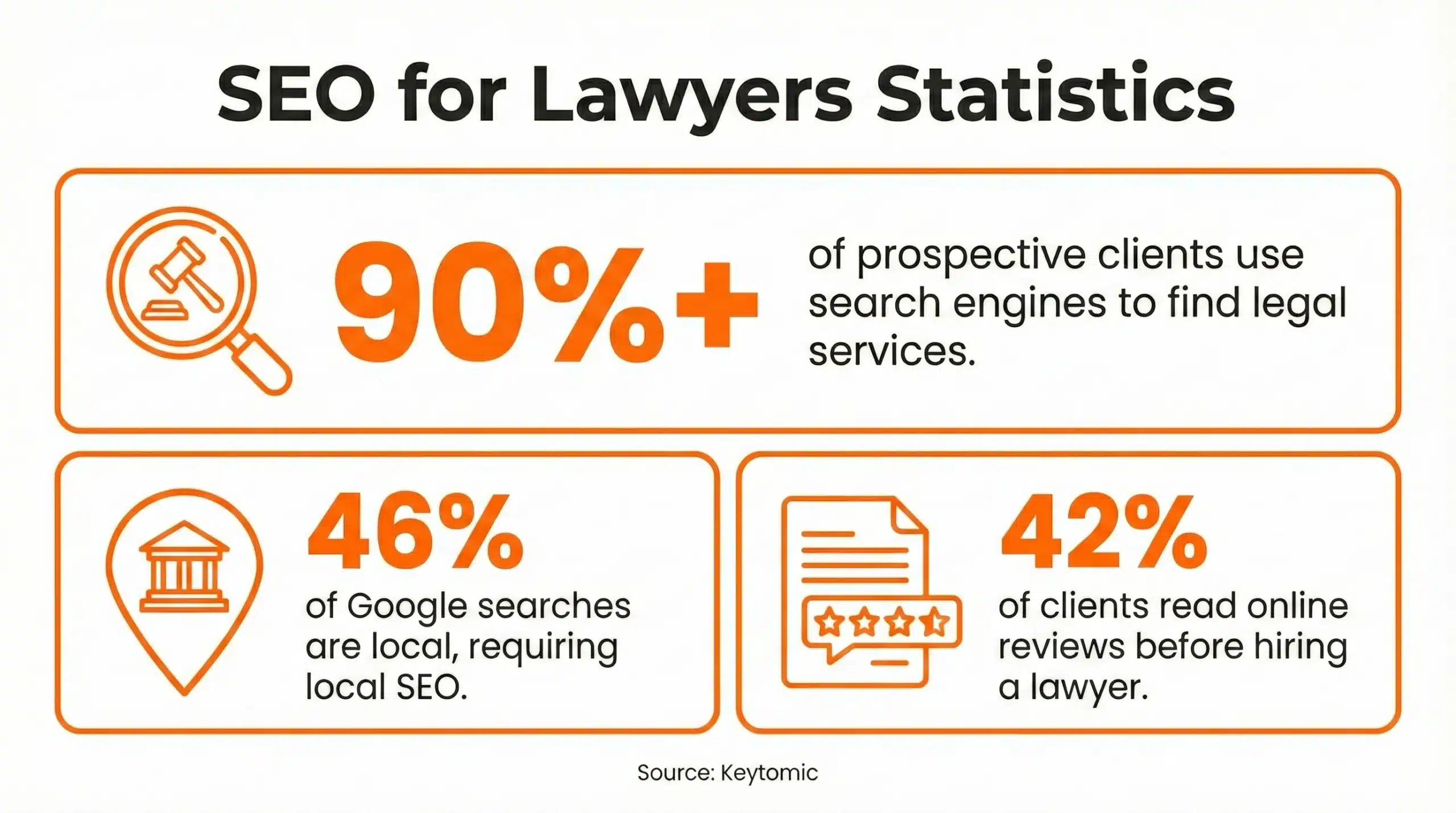
Google’s job is simple: show people the best, most relevant results for their search.
When someone searches for a lawyer, Google evaluates hundreds of factors to decide which law firms deserve to rank on page 1. Understanding these ranking factors helps you optimize your website to meet Google’s criteria.
The Four Pillars of Law Firm SEO
Every successful law firm SEO strategy rests on four foundational pillars:
1. Content Quality & Relevance
Your website needs high-quality content that actually answers the questions potential clients are asking. Google evaluates whether your content is comprehensive, accurate, and genuinely helpful. Thin, generic content that just repeats keywords won’t rank anymore.
2. Authority & Trust Signals (E-E-A-T)
Google looks for signals that your firm is experienced, expert, authoritative, and trustworthy. This includes backlinks from reputable websites, positive reviews, professional credentials, case results, and content written or reviewed by actual attorneys.
3. Technical Website Performance
Your website needs to be fast, secure (HTTPS), mobile-friendly, and easy for Google to crawl and index. Technical problems can completely block you from ranking no matter how good your content is.
4. Local Presence & Citations
For law firms serving specific geographic areas, local SEO is critical. This includes your Google Business Profile optimization, consistent NAP (Name, Address, Phone) across the web, local directory listings, and location-specific content.
E-E-A-T: The Most Important Ranking Factor for Lawyers
Google introduced E-E-A-T (Experience, Expertise, Authority, Trustworthiness) as a quality framework specifically for industries like law, medicine, and finance where inaccurate information can harm people. Your law firm needs to demonstrate all four:
Experience:
Show that your firm has real-world experience handling cases. Include case results, years in practice, successful verdicts and settlements, and specific examples of cases you’ve handled. Google wants to see that you’ve actually done the work, not just written about it.
Expertise:
Demonstrate your legal knowledge through comprehensive, accurate content. Have licensed attorneys write or review your content. Include author bios that list credentials, bar admissions, education, and specializations. The more you can prove your expertise, the better.
Authority:
Build authority through backlinks from other respected websites, mentions in news outlets, recognition from legal organizations, and positive reviews. When other credible sources cite your firm as an authority, Google takes notice.
Trustworthiness:
Make your website secure (HTTPS), transparent about who you are, and easy to contact. Display your physical address, phone number, bar license numbers, and professional affiliations. Collect and showcase client reviews. Be honest in your content about what clients can expect.
User Intent: What Your Clients Are Actually Searching For
Not all searches have the same intent. Understanding what someone actually wants when they search helps you create the right content to match that intent.
Intent Type | Example Searches | What They Want | Best Content Type |
|---|---|---|---|
Informational | “What is premises liability” | Learning about legal concepts | Blog posts, guides, FAQs |
Commercial Investigation | “Best divorce lawyer in Dallas” | Comparing options before hiring | Service pages, reviews, case results |
Transactional | “Hire DUI lawyer near me now” | Ready to contact a lawyer immediately | Service pages, contact forms, click-to-call |
Local | “Personal injury attorney Chicago” | Finding local legal help | Google Business Profile, location pages |
Match your content to the intent behind the keywords you’re targeting. Someone searching “what is a personal injury claim” wants education, not a hard sell. Someone searching “hire car accident lawyer in Miami” wants to contact you right now. Give them what they’re looking for.
Google’s Local Ranking Factors for Law Firms
For local searches (which includes most legal searches), Google uses specific factors to determine which law firms to show:
Proximity:
How close your firm is to the person searching matters significantly. You can’t fake location, so focus on optimizing for the areas where you actually have offices.
Google Business Profile Optimization:
Your complete, accurate, and active Google Business Profile is the foundation of local SEO. This includes your business information, categories, hours, photos, posts, and especially reviews.
Reviews and Ratings:
Review quantity, quality, velocity (how often you get new reviews), and diversity across multiple platforms all impact your local rankings. Reviews are consistently one of the strongest local ranking factors.
NAP Consistency:
Your Name, Address, and Phone number must be identical everywhere they appear online. Inconsistencies confuse Google and hurt your rankings.
Keyword Research for Lawyers: Finding What Your Clients Search
Keyword research is the foundation of SEO for law firms.
It tells you what potential clients are actually typing into Google when they need legal help. Most law firms skip this step and just guess at keywords, which is why most law firms struggle with SEO.
Why Most Law Firms Get Keyword Research Wrong
Law firms make a common mistake: they optimize for words lawyers use instead of words clients use.
You might describe your practice as “complex litigation” but your clients search for “how to sue someone.” You say “estate planning” but they search “do I need a will.”
This disconnect kills SEO before it starts. Google shows results that match what people actually search for, not what you wish they would search for.
Your job is to bridge that gap and create content around the words your clients use, not the legal jargon you prefer.
Another mistake is chasing high-volume keywords without considering intent. “Lawyer” gets millions of searches per month but “lawyer” by itself is useless.
Someone searching just “lawyer” could be a student doing research, someone looking for TV show recommendations, or someone in Croatia looking for local legal help.
Compare that to “car accident lawyer in Seattle” which is someone who needs your services right now.
Types of Keywords Every Law Firm Should Target
Practice Area Keywords
These are your core keywords combining your practice area with your legal specialty. Examples include “personal injury lawyer,” “divorce attorney,” “criminal defense lawyer,” “estate planning attorney,” and “business litigation lawyer.” These should be your primary targets for your main service pages.
Structure these on your website with dedicated service pages for each practice area. If you practice multiple areas, create separate optimized pages for each one rather than trying to rank one page for everything.
Location-Based Keywords
Most legal searches include location. People search for “divorce attorney in Austin,” “Boston car accident lawyer,” or “DUI lawyer near me.”
These location combinations are gold for law firms because they target people in your service area ready to hire.
For multi-location firms, create unique location pages for each office. Don’t just copy and paste the same content with different city names. Google will see that as duplicate content and won’t rank any of them well.
Long-Tail Keywords
Long-tail keywords are longer, more specific phrases that have lower search volume but much higher intent and conversion rates.
Examples include “how much does a car accident lawyer cost in Miami,” “do I need a lawyer for a minor car accident,” or “what to do after a slip and fall accident at work.”
These keywords are easier to rank for because they have less competition. They also convert better because the searcher is being very specific about what they need.
A single blog post targeting a long-tail keyword can bring in dozens of high-quality leads per month.
Question Keywords
People ask Google questions about their legal problems. These question-based searches are perfect opportunities to provide helpful answers and capture attention early in the client’s research process.
Industry Insight
Common question patterns include “Do I need a lawyer if…”, “What should I do after…”, “How long does it take to…”, “How much does it cost to…”, and “What happens if…”. Create FAQ pages and blog posts that directly answer these questions.
Free Tools for Lawyer Keyword Research
You don’t need expensive tools to do effective keyword research. These free tools will get you started:
Google Keyword Planner:
Free through Google Ads, this tool shows search volume and competition for keywords. Enter a practice area or service, and it suggests related keywords with data on how many people search for each one monthly.
Google Search Autocomplete:
Start typing a keyword into Google and look at the suggestions that drop down. These are real searches people are making. Type “divorce lawyer” and Google will suggest “divorce lawyer near me,” “divorce lawyer cost,” “divorce lawyer consultation,” and more.
“People Also Ask” Boxes:
When you search for a keyword, Google often shows a “People Also Ask” section with related questions. These are gold for FAQ content and blog topics. Click into each question to see even more related questions.
Answer the Public:
This free tool (answerthepublic.com) visualizes all the questions people ask around a keyword. Enter “personal injury” and it shows hundreds of question variations people actually search for.
Use these tools to build a list of 20-30 target keywords for your practice area and location. Prioritize keywords with clear commercial intent (people looking to hire) over purely informational keywords (people just learning).
Competitor Keyword Analysis
Your competitors who rank well are doing something right. Analyzing what keywords they rank for reveals opportunities and gaps in your strategy.
Tools like Ahrefs or SEMrush (paid) or Ubersuggest (free version available) let you enter a competitor’s domain and see all the keywords they rank for.
Look for keywords where competitors rank on page 1 or 2 that you don’t rank for at all. These are your opportunities.
Also look for keywords where your competitors have weak content. You can create better, more comprehensive content and outrank them.
Competitor Analysis Best Practices
Start with 10-20 high-intent keywords combining your practice area with location (e.g., “estate planning lawyer Portland”).
Long-tail keywords with 4+ words have lower competition and higher conversion rates.
Focus on what clients actually ask, not legal terminology you prefer.
Use free tools like Google Autocomplete and People Also Ask to find real search queries.
Creating Content That Ranks and Converts Clients
Content is what makes SEO work. Google ranks web pages with content, not websites. Every piece of content you create is another opportunity to rank for keywords, demonstrate expertise, and attract potential clients. But not all content is created equal.
The Content Types Every Law Firm Website Needs
Service Pages (Your Money Pages)
Service pages are your main pages targeting your core practice areas. These are your most important pages because they target keywords with commercial intent.
Someone searching “personal injury lawyer in Denver” is looking for these pages.
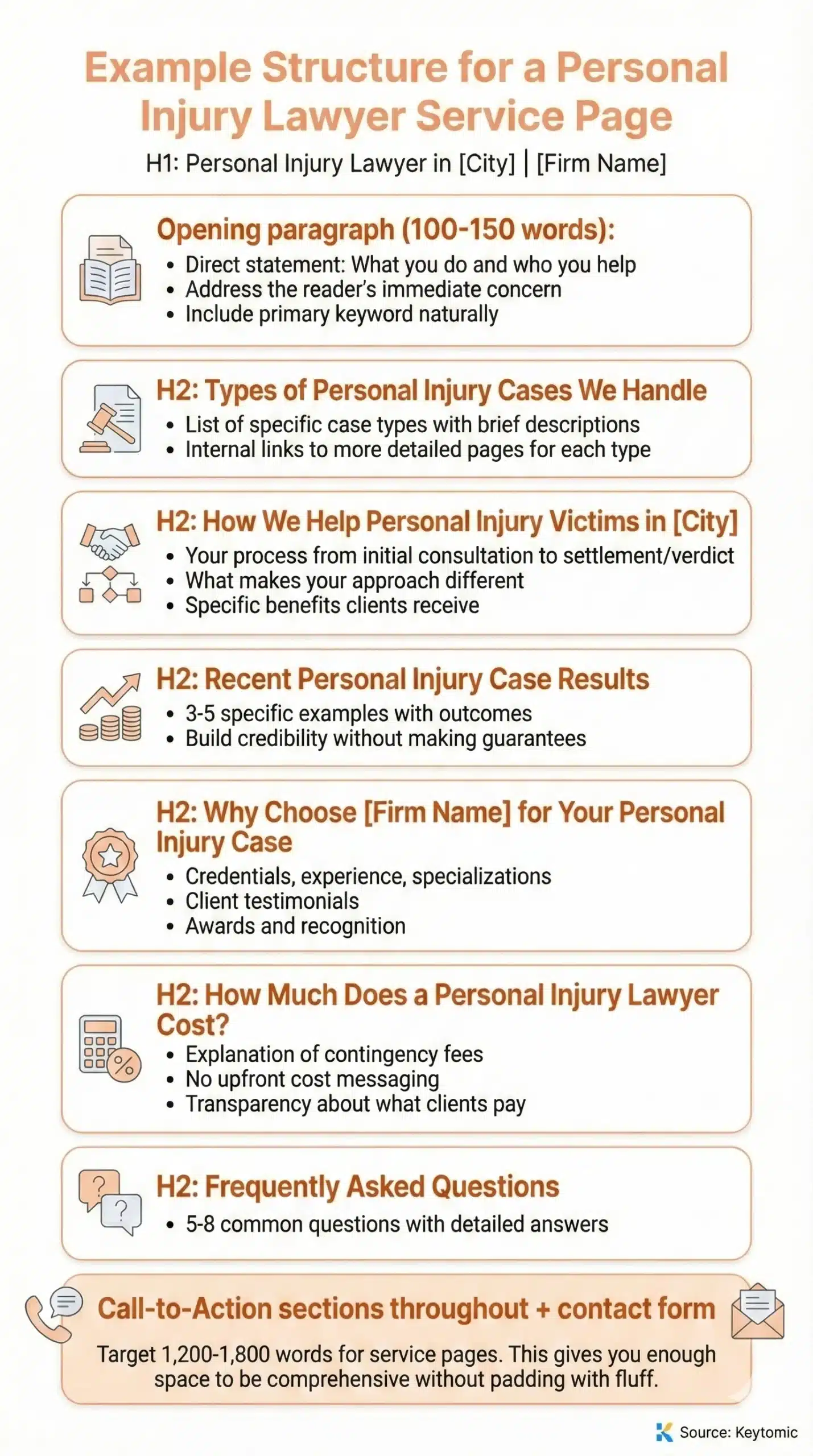
A high-converting service page includes a clear headline with your primary keyword, a compelling opening that addresses the client’s pain point, comprehensive information about your services, specific examples or case results, trust signals like credentials and reviews, and multiple clear calls-to-action.
Example structure for a personal injury lawyer service page:
Practice Area Pages
These pages go deeper into specific practice areas than your main service pages. If “Personal Injury” is your service page, you might have practice area pages for “Car Accident Lawyer,” “Slip and Fall Attorney,” “Medical Malpractice Lawyer,” and “Wrongful Death Attorney.”
These pages target more specific long-tail keywords and build topical authority. They let you create comprehensive content for each specialty rather than trying to cram everything into one service page.
Blog Posts & Educational Content
Blogging remains one of the most effective SEO strategies for law firms. Blog posts let you target informational and question-based keywords that bring traffic from people earlier in their research process. These readers may not hire you today, but they’ll remember your firm when they need help.
Blog content ideas that bring traffic:
Ultimate guides (e.g., “The Complete Guide to Filing a Workers’ Comp Claim in California”)
Process explainers (e.g., “What Happens During a Divorce in Texas: Timeline and Steps”)
Common mistakes (e.g., “7 Things Never to Say to Insurance After a Car Accident”)
Cost breakdowns (e.g., “How Much Does It Really Cost to Create a Trust?”)
Legal changes and updates (e.g., “New DUI Laws in Florida for 2026: What You Need to Know”)
Publish 2-4 high-quality blog posts per month minimum. Consistency matters more than volume. Regular publishing signals to Google that your website is active and authoritative.
Location Pages
If you have multiple office locations, create unique location pages for each one. These pages should target location-specific keywords like “family law attorney in Austin” or “criminal defense lawyer in Brooklyn.”
The challenge with location pages is avoiding duplicate content. Don’t just copy the same content and swap city names. Make each location page unique by including:
Location-specific information (local courts, county-specific procedures)
Photos of that specific office and team
Reviews from clients in that location
Local directions and parking information
Community involvement in that area
Staff bios for attorneys at that location
FAQ Pages
FAQ pages are SEO gold. They let you target dozens of question-based keywords on a single page. Structure them with each question as an H2 or H3 heading followed by a detailed answer. This makes it easy for Google to extract your answers for featured snippets.
Implement FAQ schema markup to get rich results in search. This structured data tells Google explicitly that your content is a FAQ, increasing your chances of appearing in the “People Also Ask” boxes.
Content Length: How Long Should Law Firm Content Be?
There’s no magic word count, but here’s what works for different content types:
Content Type | Target Word Count | Why |
|---|---|---|
Service Pages | 1,200-1,800 words | Comprehensive enough to cover topic thoroughly without fluff |
Location Pages | 800-1,200 words | Enough to be unique and valuable without forcing thin content |
Blog Posts | 1,500-3,000 words | In-depth enough to rank against competing content |
Ultimate Guides | 3,000-6,000+ words | Definitive resources that earn backlinks and authority |
FAQ Pages | 1,000-2,000 words | Multiple questions and detailed answers |
Quality always beats quantity. A tight 1,500-word blog post that actually helps people beats a rambling 3,000-word post padded with fluff. Write as much as it takes to thoroughly cover the topic, then stop.
On-Page SEO Checklist for Law Firm Content
Every piece of content you create needs proper on-page optimization:
Title Tags
Include your primary keyword near the beginning of your title tag. Keep titles under 60 characters so they don’t get cut off in search results. Make them compelling, not just keyword lists. “Car Accident Lawyer Miami | Free Consultation | Smith & Jones” works better than “Car Accident Lawyer Miami Florida Personal Injury Attorney.”
Meta Descriptions
Write compelling 150-160 character descriptions that make people want to click. Include your keyword and a clear value proposition. “Injured in a car accident in Miami? Our personal injury lawyers have recovered $50M+ for accident victims. Free consultation. Call 24/7.”
Header Tags
Use a single H1 tag for your main headline (include primary keyword). Use H2s for major sections (include related keywords naturally). Use H3s for subsections. Proper heading hierarchy helps Google understand your content structure.
Keyword Placement
Include your primary keyword in the first 100 words, in at least one H2, and naturally throughout the content. Don’t force it or repeat it unnaturally. Include related keywords and synonyms to cover the topic comprehensively.
Image Optimization
Name image files descriptively before uploading (e.g., “miami-car-accident-lawyer.jpg” not “IMG_1234.jpg”). Write descriptive alt text for every image that includes keywords when relevant but primarily describes the image for accessibility.
Internal Linking
Link from new content to existing relevant pages on your site. This helps Google discover pages, spreads authority, and keeps visitors engaged longer. Link using descriptive anchor text that tells readers what they’ll find (e.g., “learn more about filing a workers’ comp claim” not “click here”).
URL Structure
Keep URLs short, descriptive, and keyword-rich. “yourfirm.com/personal-injury-lawyer-miami” is better than “yourfirm.com/page?id=12345.” Use hyphens to separate words, not underscores.
Local SEO for Lawyers: Dominating Your Geographic Market
Local SEO is non-negotiable for law firms. Most legal services require in-person meetings or at minimum serving clients in specific jurisdictions.
Local SEO ensures you appear when potential clients in your area search for legal help.
Consider this: 76% of people who search for “lawyer near me” or similar local queries visit a law firm within 24 hours. 28% of those searches result in a hire.
If you’re not showing up in local search results, you’re invisible to the majority of your potential clients.
Google Business Profile Optimization
Your Google Business Profile (formerly Google My Business) is the foundation of local SEO.
It makes you eligible to appear in the local pack, the map results that show above organic results for local searches. These three map results get massive amounts of clicks.
Claiming and Verifying Your Profile
If you haven’t already, search for your firm on Google Maps. If a listing exists, claim it. If not, create one at business.google.com.
Google will verify your business through a postcard sent to your physical address with a verification code. This usually takes 5-7 days.
Never try to game the system by creating multiple listings for one location or using fake addresses. Google actively fights spam and will suspend profiles that violate guidelines. Play by the rules.
Complete Profile Optimization
Fill out every single field in your Google Business Profile:
Business Name
Use your actual legal business name as registered. Don’t stuff keywords into your business name like “John Smith Law Firm Personal Injury Attorney Miami.”
Google will likely flag and remove it. Legitimate location descriptors are okay if they’re part of your actual name (e.g., “Smith Law Group of Miami”).
Categories
Choose your primary category carefully as it has the most impact. “Lawyer” or “Law Firm” is usually best for the primary.
Add secondary categories for specialties like “Personal Injury Attorney,” “Divorce Lawyer,” or “Criminal Defense Attorney.” You can add up to 10 categories.
Business Description
Write a compelling 750-character description of your firm. Include what you do, who you serve, your experience, and what makes you different.
Mention your practice areas and location naturally without keyword stuffing.
Hours of Operation
Keep these accurate and update them for holidays. Incorrect hours frustrate potential clients and hurt your ranking.
Service Areas
If you serve clients outside your immediate city, add your service areas. This tells Google to show your profile for searches in those locations.
Attributes
Enable relevant attributes like “Wheelchair accessible entrance,” “LGBTQ+ friendly,” or “Language assistance.” These help you appear for more specific searches.
Photos and Videos
Upload high-quality photos of your office exterior and interior, your team, and meeting areas. Add new photos monthly to signal an active, well-maintained profile.
Profiles with photos get 42% more requests for directions and 35% more clicks to their websites.
Google Posts
Publish posts weekly about recent case results (within ethical guidelines), news, blog articles, or firm updates. Posts appear in your profile and signal freshness to Google.
The Review Factor
Reviews are consistently ranked as one of the top three local ranking factors. They also heavily influence potential clients’ decisions to contact you.
A firm with 100+ positive reviews will get more calls than a firm with 5 reviews, even if both rank in similar positions.
How to Ethically Get More Google Reviews
You can and should ask satisfied clients for reviews, but you must do it ethically within your jurisdiction’s bar rules. Most states allow asking for reviews as long as you don’t offer compensation or pressure clients.
Create a simple review request process:
After successfully closing a case, send a thank-you email or letter
Include a direct link to leave a Google review (find your link in your Google Business Profile dashboard)
Keep it simple: “We would appreciate if you’d share your experience by leaving a review”
Make it easy by providing the direct link rather than making them search
Send these requests to 100% of your satisfied clients. Only about 10-15% will actually leave a review, so you need to ask consistently. The math works out: if you close 50 cases per year and 12% leave reviews, you’ll get 6 reviews per year, which isn’t enough. Close 200 cases and ask all of them, you’ll get 24 reviews, which builds momentum.
Responding to Reviews
Respond to every review, positive and negative. Thank people for positive reviews.
For negative reviews, respond professionally, acknowledge their concern, and offer to discuss offline. Never get defensive or argue publicly.
Example negative review response: “Thank you for sharing your feedback. We’re sorry your experience didn’t meet expectations. We’d appreciate the opportunity to discuss this further. Please contact our office manager at [email] or [phone] so we can address your concerns directly.”
NAP Consistency Across the Web
NAP stands for Name, Address, Phone number. These three pieces of information must be exactly identical everywhere they appear online. Inconsistencies confuse Google and hurt your local rankings.
Check your NAP consistency across:
Your website (footer, contact page, location pages)
Google Business Profile
Facebook business page
Legal directories (Avvo, Justia, FindLaw, etc.)
General directories (Yelp, Bing Places, Apple Maps)
Industry associations
Local chamber of commerce listings
Even small differences matter. “123 Main St” vs “123 Main Street” or “Suite 200” vs “Ste 200” are seen as different addresses by Google’s algorithm. Pick one format and use it everywhere.
Local Citations & Directory Listings
Citations are mentions of your law firm’s NAP information on other websites. They function as validation to Google that your business is legitimate and established. More citations from quality sources improves local rankings.
Top Legal Directories Every Lawyer Should Be On:
Directory | Type | Cost | Value for SEO |
|---|---|---|---|
Avvo | Legal | Free profile, paid upgrades | High – major legal directory |
Justia | Legal | Free | High – highly trusted by Google |
FindLaw | Legal | Paid | Medium – established but mostly paid |
Lawyers.com | Legal | Free profile, paid upgrades | Medium – part of Martindale |
Martindale-Hubbell | Legal | Free profile, paid upgrades | High – oldest legal directory |
Google Business Profile | General | Free | Critical – must have |
Bing Places | General | Free | Medium – secondary search engine |
Apple Maps | General | Free | Growing – voice search |
Yelp | General | Free | Medium – reviews matter here |
Create complete profiles on the free legal directories. For paid directories, evaluate ROI based on your practice area and market. Personal injury and criminal defense often see strong returns from paid profiles. More specialized practices may not.
Local Link Building Strategies
Local backlinks from websites in your geographic area signal relevance for local searches. These strategies work well for law firms:
Sponsor Local Events: Sponsoring charity runs, school events, or community festivals often includes a link from the event website. These are legitimate, relevant local links.
Local News Mentions: Offer expert legal commentary to local news outlets. When they quote you, they often link to your website. Build relationships with local reporters who cover crime, accidents, legal issues, or business news.
Bar Association Memberships: Join your state, county, and city bar associations. Most include member directories with links. These are highly authoritative links from trusted legal organizations.
Community Involvement: Volunteer with local nonprofits, serve on boards, or teach free legal clinics. Many will link to your website from their partner pages.
Local Business Partnerships: Partner with complementary local businesses (accountants, financial planners, real estate agents) and link to each other’s websites as trusted referrals.
Focus on quality local links from real organizations in your community, not spammy directory submissions or paid link schemes.
Link Building for Law Firms: Earning Authority
Backlinks are still one of the most powerful ranking factors. When another website links to yours, it’s essentially a vote of confidence.
Google views backlinks as endorsements, and pages with more high-quality backlinks generally rank higher.
But not all links are created equal. One link from a major university’s legal resource page is worth more than 100 links from random low-quality directories. Quality beats quantity every time.
Why Backlinks Still Matter in 2026
Some marketers claim links don’t matter anymore, but data consistently shows otherwise.
Studies analyzing ranking factors find that backlinks correlate more strongly with rankings than any other factor. Google’s own statements confirm links remain important, though they’ve gotten better at identifying unnatural links.
Think of backlinks as reputation. If respected legal publications, universities, bar associations, and news outlets all link to your firm’s website, Google infers that you must be authoritative and trustworthy. If the only websites linking to you are spammy directories nobody’s heard of, you don’t have much authority.
Types of Backlinks That Help Law Firms Rank
Editorial Links
These are links you earn naturally because you created something valuable. Editorial links are the gold standard because they’re genuine endorsements. Examples include guest posts on respected legal blogs, quotes in news articles, links from journalists who found your content useful, and citations from academic or legal research.
Resource Links
These come from pages that compile useful resources. Think “best personal injury lawyers in Texas” roundups, state bar association resource directories, university legal aid resources, or government websites linking to helpful legal information.
Relationship-Based Links
These come from professional associations and organizations you belong to. State and local bar associations, legal specialization boards, law school alumni associations, professional legal organizations, and legal aid societies often maintain member directories with links.
White Hat Link Building Strategies
Create Ultimate Guides Worth Linking To
Comprehensive guides on legal topics naturally attract links because they’re useful reference materials. Other lawyers, legal bloggers, and educational websites link to them as resources.
Your “Complete Guide to Filing for Divorce in California” might get links from family law bloggers, legal aid organizations, and even other attorneys’ websites.
Original Research and Surveys
Publishing original data or research creates highly linkable assets. Survey your clients, analyze public records, or compile statistics about legal trends in your area. Legal publications and news outlets love citing original data.
Digital PR for Law Firms
Actively pitch your expertise to journalists and publications. Use services like HARO (Help A Reporter Out) where journalists request expert sources.
Monitor local news for stories where you could provide expert commentary. When quoted or featured, you’ll often get a backlink.
Broken Link Building
Find broken links on legal websites pointing to content that no longer exists. If you have similar content, contact the site owner and suggest they replace the broken link with a link to your resource.
This works particularly well with bar association resource pages and legal education websites.
Unlinked Mentions
Search for mentions of your firm’s name that don’t include a link. Use Google search: “your firm name” -site:yourwebsite.com to find these.
Contact the website and politely ask them to link the mention. Many will happily add the link since they already mentioned you.
Link Building Mistakes to Avoid
Don’t Buy Links
Paying for links violates Google’s guidelines. If caught, you risk a manual penalty that can devastate your rankings. It’s not worth the risk when legitimate strategies work better long-term.
Avoid Link Farms and PBNs
Private Blog Networks (PBNs) and link farms are networks of websites created solely to sell links. Google has gotten very good at identifying and devaluing these. They’ll hurt you, not help.
Don’t Over-Optimize Anchor Text
If every backlink to your site uses the exact same keyword anchor text (“personal injury lawyer Miami”), it looks manipulative. Natural link profiles have varied anchor text including your brand name, generic phrases like “click here,” and natural contextual variations.
Skip Irrelevant Directory Spam
Submitting your site to hundreds of random directories wastes time and can hurt you. Focus on quality legal directories and relevant local directories only.
Link Building Best Practices
Aim to earn 5-10 high-quality backlinks per month through relationship-building and content creation.
One link from a trusted legal publication provides more value than 100 low-quality directory links.
Focus on creating resources worth linking to rather than chasing backlinks directly.
Avoid paid links, link schemes, and anything that violates Google’s guidelines.
Technical SEO for Law Firm Websites
Technical SEO ensures Google can find, crawl, and index your website properly. Even with amazing content and links, technical problems can completely prevent you from ranking.
The good news is most technical issues have straightforward fixes.
Website Speed Optimization
Page speed affects both rankings and user experience. Google explicitly states that speed is a ranking factor.
More importantly, slow pages frustrate visitors. 53% of mobile users abandon sites that take longer than 3 seconds to load.
Test your site speed using Google’s PageSpeed Insights (free). It analyzes your page and provides specific recommendations. Aim for a score of 80+ on both mobile and desktop.
Common speed issues and fixes:
Large Unoptimized Images
Images often account for most of a page’s file size. Compress images before uploading using tools like TinyPNG or ImageOptim. Aim for images under 200KB each.
Too Many Plugins (WordPress)
Every plugin adds code that must load. Audit your plugins and deactivate ones you don’t actually use. Some plugins are particularly slow and should be replaced with lighter alternatives.
No Caching
Caching stores static versions of your pages so the server doesn’t have to rebuild everything from scratch for each visitor. Use a caching plugin like WP Rocket or W3 Total Cache for WordPress sites.
Slow Web Hosting
Budget hosting with shared servers can’t deliver pages quickly. If you’ve tried everything and your site is still slow, upgrade to better hosting.
Quality managed WordPress hosting typically costs $25-50/month and delivers significantly faster performance.
Mobile-Friendly Website (Responsive Design)
Over 60% of legal searches happen on mobile devices. Google uses mobile-first indexing, meaning it primarily uses the mobile version of your site for ranking. If your site doesn’t work well on phones, you won’t rank well.
Test your mobile-friendliness with Google’s Mobile-Friendly Test (free). It shows exactly how Google sees your mobile site.
Common mobile issues:
Text Too Small: Body text should be at least 16px. Smaller text forces users to zoom in, creating a poor experience.
Buttons Too Close Together: Touch targets (buttons, links) need adequate spacing so people don’t accidentally tap the wrong thing. Minimum 48px tall with spacing between.
Content Wider Than Screen: If users have to scroll horizontally, your site isn’t responsive. Content should automatically adjust to fit any screen width.
Interstitials Covering Content: Pop-ups that cover the entire screen on mobile (especially immediately on page load) can trigger penalties. Use less intrusive alternatives or delay pop-ups until the user has engaged with content.
Website Security (HTTPS/SSL Certificate)
Google requires HTTPS (the padlock in the browser address bar) for all websites. Sites without HTTPS show a “Not Secure” warning that scares visitors away. HTTPS is also a ranking factor.
Get an SSL certificate from your hosting provider. Most hosts now include free SSL certificates. Installation is usually one-click from your hosting control panel. After installing, redirect all HTTP traffic to HTTPS so visitors always see the secure version.
Check for mixed content warnings (pages loading both HTTPS and HTTP resources) which break the secure connection. Use a plugin like Really Simple SSL to fix these automatically on WordPress sites.
Site Architecture & Navigation
Google needs to discover and understand your website structure. A logical hierarchy with clean internal linking makes this easy.
Logical URL Structure: Keep URLs short and descriptive: yourfirm.com/criminal-defense not yourfirm.com/services/practice-areas/criminal/defense/index.php?page=1
Clear Site Hierarchy: Organize content in logical categories. Homepage links to main practice areas, practice areas link to specific services, blog posts link to related content.
XML Sitemap: Create an XML sitemap listing all your important pages and submit it to Google Search Console. This helps Google discover pages faster. WordPress SEO plugins like Yoast create sitemaps automatically.
Internal Linking: Link from new content to existing relevant pages. This helps Google discover pages and understand relationships between content. Every new blog post should link to 2-3 relevant existing pages.
Schema Markup for Law Firms
Schema markup is code that helps search engines understand your content better. It can make your listings stand out with rich results in search, potentially including star ratings, business hours, or FAQ answers directly in results.
The most valuable schema types for law firms:
Attorney/Law Firm Schema: Identifies your business as a law firm and specifies practice areas, locations, and founding date.
LocalBusiness Schema: Provides structured data about your location, hours, and contact info for local search.
FAQPage Schema: Marks up your FAQ content so Google can display your answers in search results and “People Also Ask” boxes.
Review Schema: Displays star ratings in search results when you have reviews.
Implement schema using WordPress plugins like Rank Math or Schema Pro, or hire a developer to add it manually. Test your schema with Google’s Rich Results Test to ensure it’s correct.
Measuring SEO Success: Tracking What Matters
SEO without measurement is guesswork. You need to track specific metrics to know what’s working, what’s not, and where to invest more effort.
The right metrics tell you if your SEO investment is paying off or if you need to adjust your strategy.
The Metrics That Actually Matter
Organic Traffic Growth
The most fundamental metric is how many people visit your site from organic search. Track this month-over-month in Google Analytics. Healthy SEO should show steady traffic growth of 10-25% month-over-month in the first 6-12 months.
Keyword Rankings
Track where you rank for your target keywords. Rankings alone don’t matter (traffic and leads do), but they’re a useful leading indicator. If you’re moving from page 3 to page 2 to page 1, you’re headed in the right direction even if traffic hasn’t spiked yet.
Leads from Organic Search
Traffic is meaningless if it doesn’t convert. Track how many contact forms, phone calls, and consultations come from organic search. This tells you if you’re attracting the right kind of traffic.
Cases Signed from SEO
The ultimate metric is actual cases signed. Work with your intake team to track where each signed case originated. Calculate your cost per case from SEO versus other marketing channels.
Return on Investment
Compare what you spend on SEO monthly to the revenue generated from SEO-driven cases. Most law firms see ROI turn positive around month 6-9 and hit 6-10x ROI by month 18-24.
Setting Up Google Analytics 4 for Law Firms
Google Analytics shows you who visits your website, where they come from, what they do, and whether they convert. It’s free and essential.
Installation: Create a Google Analytics account and add the tracking code to your website. Most WordPress themes have a field to paste your tracking ID, or use a plugin like MonsterInsights.
Set Up Conversion Tracking: Define what counts as a conversion (contact form submission, phone click, email click, chat start). Set up events to track these actions. This lets you see which pages and traffic sources generate leads.
Create Custom Reports: Build reports specific to legal marketing showing organic traffic by practice area, conversion rates by landing page, and lead sources. Google Analytics 4’s customization lets you focus on what matters for your firm.
Using Google Search Console
Google Search Console (free) is your direct line to Google. It shows you how Google sees your site, what keywords you rank for, technical issues affecting your site, and more.
Key Reports:
Performance Report: Shows impressions (how often you appear in search), clicks, average position, and click-through rate for every keyword.
This data is gold for identifying opportunities. Look for keywords where you rank on page 2 (positions 11-20) with decent impressions. These are prime candidates to target with better content.
Index Coverage: Shows which pages Google has indexed and any indexing problems. Fix errors that prevent pages from being indexed.
Mobile Usability: Identifies mobile-specific issues affecting user experience.
Manual Actions: If Google manually penalizes your site, you’ll be notified here. Most sites never get manual actions, but check regularly just in case.
Setting Realistic Expectations
SEO takes time. Don’t expect overnight results. Here’s a realistic timeline:
Months 1-3: Foundation building. You’ll see minimal results but you’re laying groundwork. Some quick wins possible for easy keywords.
Months 3-6: Early traction. You’ll start seeing rankings improve for long-tail keywords and traffic begin to grow. Some leads coming in.
Months 6-12: Momentum building. Traffic grows steadily, more keywords ranking, leads increasing. ROI likely turning positive.
Months 12-18: Compounding returns. Traffic and leads growing faster, ranking for competitive keywords, strong positive ROI.
18+ months: Mature strategy. Dominant rankings in your market, consistent high-volume traffic, predictable lead generation.
Industry Insight
Competitive markets take longer. A solo practitioner in a small town might see great results in 6 months. A personal injury firm in Manhattan competing against firms spending $100K+/month on SEO will need 18-24 months to break through.
SEO for Different Types of Law Firms
SEO strategy varies by practice area because search behavior and competition differ significantly. What works for a local family law practice won’t necessarily work for a national class action firm.
Personal Injury Lawyer SEO
Personal injury is the most competitive legal vertical for SEO. High case values mean firms invest heavily in SEO, making it expensive and time-consuming to compete. Average cost-per-click for personal injury keywords ranges from $100-$500 on Google Ads, indicating intense competition.
Strategy Focus:
Target very specific long-tail keywords initially: “truck accident lawyer in [neighborhood]” rather than just “personal injury lawyer [city].” The latter is too competitive for most firms without massive budgets.
Create detailed content about specific accident types: car accidents, truck accidents, motorcycle accidents, pedestrian accidents, slip and fall, dog bites, etc. Each should have a comprehensive page.
Build authority through case results (within ethical guidelines), client testimonials, and links from news outlets covering your cases. Local news coverage of settlements or verdicts provides valuable backlinks.
Invest heavily in local SEO and Google Business Profile optimization. Most personal injury clients want a lawyer near them.
Family Law Attorney SEO
Family law involves emotional, stressful situations.
Searchers are often in crisis mode looking for immediate help. They’re reading extensive content to understand their situation before contacting lawyers.
Strategy Focus:
Create extensive FAQ content answering every question someone might have about divorce, custody, child support, alimony, property division, etc. These queries have high search volume and low competition relative to personal injury.
Target question-based keywords: “do I need a lawyer for uncontested divorce,” “how is child custody determined in [state],” “how much is alimony in [state].”
Create process guides walking people through each stage of divorce or custody proceedings. This builds trust and positions you as helpful and knowledgeable.
Be mindful of client privacy. Use testimonials and case examples carefully, ensuring complete confidentiality.
Criminal Defense Lawyer SEO
Criminal defense searches often happen urgently. Someone just got arrested or received charges and needs help immediately. Mobile optimization and fast page speed are critical since most searches happen on phones.
Strategy Focus:
Target urgent, high-intent keywords: “DUI lawyer [city],” “arrested for [charge] need lawyer,” “bail bondsman [city].” These convert extremely well.
Create comprehensive resources about specific charges: DUI, drug possession, assault, theft, white collar crimes, domestic violence, etc.
Make it extremely easy to contact you: prominent click-to-call buttons, 24/7 availability messaging, simple contact forms, live chat.
Build credibility through case results (within ethical rules), attorney bios highlighting experience, professional recognitions and certifications.
Local SEO matters enormously. Most people want a criminal defense lawyer familiar with their local courts and prosecutors.
Small Firm & Solo Practitioner SEO
Small firms and solos face a challenge: competing against firms with much larger budgets. The advantage is agility and the ability to focus on niche areas those bigger firms ignore.
Strategy Focus:
Dominate specific niches rather than competing broadly. Don’t try to rank for “personal injury lawyer [major city]” when that requires $100K+ budgets. Instead, target “bicycle accident lawyer [neighborhood]” or “elder abuse attorney [county].”
Focus on long-tail keywords that bigger firms consider too low-volume to bother with. These add up to significant traffic when you target hundreds of them.
Create genuinely helpful, detailed content. Big firms often produce thin content at scale. You can win by being more thorough and helpful on specific topics.
Build relationships for links rather than paying for expensive link building services. Local networking, guest posting, and creating resources worth linking to all cost time instead of money.
Consider SEO automation tools like Keytomic that let small firms produce content at scale without hiring large teams.
DIY vs Hiring an SEO Agency
Most lawyers face a decision: handle SEO themselves or hire an agency. Both approaches can work, depending on your situation, budget, and willingness to learn.
Can You Do Law Firm SEO Yourself?
Yes, but it’s a significant time commitment. SEO isn’t complicated conceptually, but it’s detail-oriented and time-consuming. You’ll need to invest 15-20 hours per week consistently for at least 6-12 months to see meaningful results.
What you can realistically do in-house:
Basic keyword research using free tools to identify target keywords for your practice area and location. This takes a few hours initially and occasional updates.
Creating content if you enjoy writing and have time. Many lawyers actually enjoy writing about their areas of expertise once they understand what topics to cover.
Basic on-page optimization, tagging title tags and meta descriptions, creating proper heading structures, and optimizing images. This is straightforward once you learn the basics.
Managing your Google Business Profile, responding to reviews, adding posts, and keeping information current. This takes 30 minutes per week.
Basic outreach for backlinks from bar associations, local organizations, and directories. This requires time but not specialized expertise.
What’s difficult to do yourself without significant learning:
Technical SEO, fixing site speed issues, implementing schema markup, handling migrations or redesigns without losing rankings. These require development skills or deep technical knowledge.
Link building at scale requires relationships, resources, and significant time investment. Building high-quality links consistently is hard.
Content production at volume, writing 8-15 high-quality blog posts per month while practicing law is unrealistic for most attorneys. The time isn’t there.
Time Investment Reality Check:
Realistically, budget 15-20 hours per week if you’re doing SEO yourself. That breaks down roughly to 4-6 hours on content creation, 2-3 hours on keyword research and optimization, 2-3 hours on link building outreach, 2-3 hours on technical maintenance, and 1-2 hours on tracking and reporting.
Most lawyers who try DIY SEO either give up after a few months because it takes too much time from their practice, or they continue but inconsistently, achieving mediocre results.
When to Hire an SEO Professional
You should seriously consider hiring help when:
Your time is more valuable elsewhere. If your billable hour is $300+, spending 15-20 hours per week on SEO means you’re sacrificing $60,000-80,000 per year in potential billing. Hiring an agency for $5,000-10,000 per month is actually cheaper.
You’re in a competitive market. Major metropolitan areas with established competitors require aggressive SEO that’s difficult to execute alone. You need professional help to compete.
You tried DIY and stalled. Many lawyers start strong with SEO but hit a wall when they need technical help or more sophisticated link building. Hiring an agency gets you past those obstacles.
You want faster results. An experienced agency knows what works and can execute quickly. They’ll accomplish in 3 months what might take you 9 months learning and executing alone.
What to Expect from an SEO Agency:
Monthly retainer typically covers strategy development, keyword research, content creation (usually 4-8 pieces per month), on-page optimization, technical SEO maintenance, link building, and monthly reporting.
Communication should include regular calls or meetings, transparent reporting showing exactly what they did and what results you’re getting, and honest timelines about when to expect results.
They should never guarantee #1 rankings. That’s a red flag. Good agencies promise consistent effort and realistic improvement but acknowledge they can’t control Google’s algorithm.
How Much Does Law Firm SEO Cost?
SEO Budget Range | What You Get | Best For |
|---|---|---|
$2,500-5,000/month | Basic SEO with 2-4 content pieces per month, basic optimization, limited link building | Small firms in less competitive markets or niche practices |
$5,000-10,000/month | Solid SEO with 6-8 content pieces per month, comprehensive optimization, consistent link building | Mid-sized firms in moderately competitive markets |
$10,000-20,000/month | Aggressive SEO with 12-15 content pieces per month, advanced technical work, substantial link building | Larger firms or small firms in highly competitive markets |
$20,000+/month | Enterprise SEO with high-volume content, aggressive link building, advanced technical implementation | Major firms competing in most competitive markets |
Your ROI typically turns positive around month 6-9 and reaches 6-10x ROI by month 18-24 if executed well. Personal injury and other high-value practice areas often see 10-15x ROI long-term.
The Keytomic Advantage: Automate Your Law Firm’s SEO Workflow
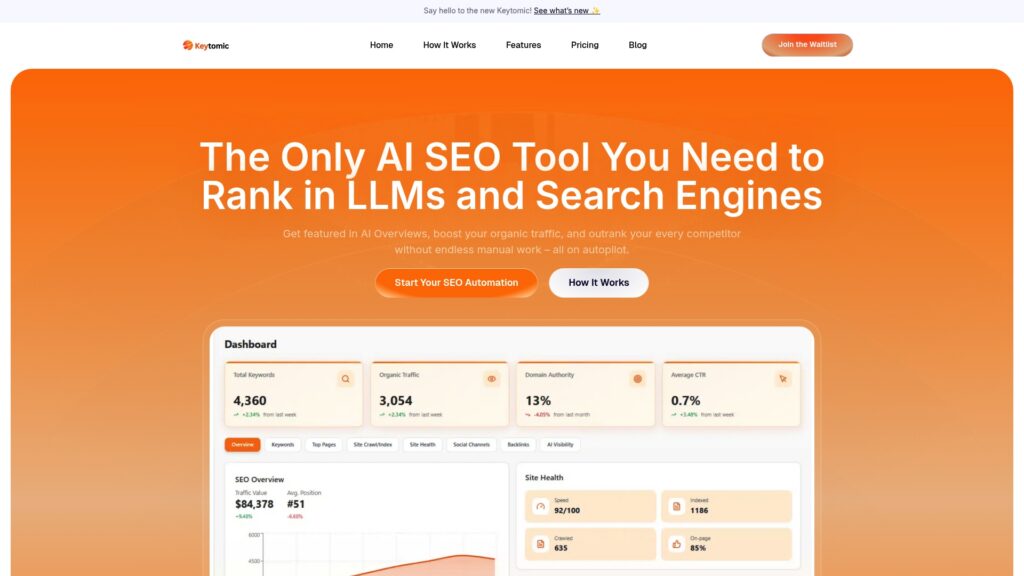
Most law firms struggle with SEO because it requires constant attention across multiple time-consuming tasks. You need keyword research, content creation, optimization, publishing, indexing, citation management, and performance tracking. All of this demands 15-20 hours per week consistently.
That’s where Keytomic changes everything.
The Manual SEO Workflow (What Most Firms Do)
When you handle SEO manually or hire a traditional agency, the workflow looks like this:
Step 1: Spend 2-3 hours doing keyword research to identify topics to target
Step 2: Spend 3-5 hours writing a single blog post or service page
Step 3: Spend 1 hour optimizing the content with keywords, headers, images, and internal links
Step 4: Spend 30 minutes publishing and formatting in WordPress
Step 5: Manually submit to Google for indexing and wait days or weeks
Step 6: Hope other search engines and AI platforms eventually find and index it
Step 7: Manually track rankings across spreadsheets
Step 8: Update content quarterly when it slips in rankings
Step 9: Repeat this entire process 8-12 times per month for consistent results
This adds up to 60-80 hours per month of work. You’re either spending that time yourself (taking you away from practicing law) or paying an agency $5,000-15,000 per month to do it for you.
The Keytomic Workflow (What Modern Firms Do)
Keytomic automates the entire SEO workflow from keyword discovery through multi-platform indexing:
Automated Keyword Research
Keytomic analyzes your practice area, location, and competition to identify high-value keywords in minutes. No manual research required. The system identifies both high-intent commercial keywords and supporting informational keywords that build authority.
AI-Powered Content Generation
Generate complete, SEO-optimized blog posts, service pages, and FAQ sections that actually rank. The content includes proper keyword integration, natural language that passes AI detection, semantic SEO optimization, and strategic internal linking.
One-Click Publishing
Content goes live on your WordPress site automatically with proper formatting, header hierarchy, image optimization, schema markup implementation, and complete meta tags.
Multi-Platform Indexing
Your content gets indexed not just on Google, but across ChatGPT, Perplexity, Gemini, and other AI search platforms simultaneously. This positions you for the future of search where people ask AI assistants questions instead of using traditional search engines.
Built-In GEO Optimization
Keytomic automatically optimizes content for Generative Engine Optimization, making your firm more likely to be cited when AI tools answer legal questions. As AI search grows, this gives you a massive advantage over competitors still focused solely on traditional Google SEO.
Automated Performance Tracking
Real-time dashboards show keyword rankings, traffic growth, and content performance without manual spreadsheet tracking.
Why Law Firms Choose Keytomic
Saves 75% of Time: What used to take 60-80 hours per month now takes 15-20 hours with Keytomic handling the heaviest lifting. You focus on strategy and practicing law while Keytomic executes the tactics.
Scales Content Production: Produce 15-20 pieces of optimized content per month without hiring a content team or burning out your attorneys writing blog posts.
Reduces Costs: Most firms using Keytomic spend 40-60% less on SEO than those paying traditional agencies while actually producing more content and getting better results.
Future-Proofs Your SEO: With built-in optimization for AI search platforms, you’re positioning your firm for how people will search in 2026 and beyond, not just how they searched in 2020.
Maintains Quality: The content Keytomic generates follows semantic SEO best practices, passes AI detection, and actually helps potential clients, which is what Google rewards.
Real Results: Law firms using Keytomic typically see organic traffic increase 200-300% within the first 6 months while spending 75% less time on content creation than they did with manual workflows or traditional agencies.
Take the manual time investment out of SEO so you can focus on practicing law. Learn more about Keytomic’s legal SEO automation.
Common SEO Mistakes Law Firms Make
Even firms investing in SEO often make critical mistakes that limit results. Avoid these common pitfalls:
Keyword Stuffing
Repeating your target keyword unnaturally throughout content hoping it will rank better. Modern Google penalizes this. Instead, use your primary keyword naturally a few times and include related terms and synonyms. Write for humans first, Google second.
Example of keyword stuffing: “Our Chicago personal injury lawyers are the best Chicago personal injury lawyers because our Chicago personal injury lawyers have handled more Chicago personal injury cases than other Chicago personal injury lawyers in Chicago.”
That’s unreadable. Write naturally: “Our personal injury lawyers in Chicago have handled over 2,000 accident cases in the past decade, recovering millions for injured clients across the Chicago area.”
Ignoring Mobile Users
Building a website that looks great on desktop but is difficult to use on phones. Since 60%+ of searches happen on mobile, this kills your conversions even if you rank well.
Test your site on actual phones, not just desktop browsers with reduced width. Forms, phone numbers, and contact buttons should be extremely easy to tap.
Thin or Duplicate Content
Creating dozens of location pages by copying and pasting the same content with different city names. Google identifies this as duplicate content and won’t rank any of them well.
The same applies to service pages that are just 200 words of generic text. They won’t rank against competitors with comprehensive 1,500+ word pages covering the topic thoroughly.
If you don’t have enough unique information to write 800+ words about a topic, combine it with related content rather than creating a thin page that won’t rank.
No Local SEO Strategy
Ignoring Google Business Profile optimization, having inconsistent NAP information, and having zero reviews. For law firms serving specific geographic areas (most of you), local SEO is the fastest path to results.
Claim and completely fill out your Google Business Profile. Get at least 10-15 reviews. Build local citations. This often produces results faster than traditional SEO.
Neglecting Technical SEO
Having a beautiful website that loads slowly, isn’t mobile-friendly, lacks HTTPS security, or has broken links that Google can’t crawl properly.
Run your site through PageSpeed Insights and Google’s Mobile-Friendly Test. Fix the issues they identify. Many technical problems have simple fixes that dramatically improve performance.
Black Hat SEO Tactics
Buying links, using private blog networks, cloaking (showing different content to Google than to users), or any other manipulative tactic to try to game rankings.
These might work briefly but Google eventually catches them and issues penalties that can take years to recover from. Legitimate white hat strategies work better long-term without the risk.
The Future of SEO for Lawyers
SEO continues to evolve rapidly. Understanding where it’s heading helps you prepare and stay ahead of competitors.
AI-Powered Search (ChatGPT, Perplexity, Gemini)
Traditional search is changing. People increasingly ask questions to AI assistants like ChatGPT, Claude, Perplexity, and Google’s AI Overviews rather than typing keywords into Google. These AI tools provide direct answers by synthesizing information from multiple sources, often without users clicking through to any website.
This shift requires a new optimization approach called Generative Engine Optimization (GEO). GEO focuses on making your content more likely to be cited by AI tools when they answer questions.
Key GEO strategies:
Structure content with clear, concise answers to specific questions. AI tools prefer content that directly answers queries without requiring extensive reading.
Use semantic SEO principles heavily. AI understands context and relationships between concepts better than traditional search algorithms.
Get indexed on multiple platforms. Don’t just optimize for Google. Make sure ChatGPT, Perplexity, Claude, and other AI tools can access your content.
Tools like Keytomic handle GEO optimization automatically, ensuring your content is structured for both traditional search and AI citations.
Google’s Continued Focus on E-E-A-T
Google will continue emphasizing Experience, Expertise, Authority, and Trustworthiness, especially for YMYL (Your Money or Your Life) topics like legal advice. This means:
Author credentials matter more. Have actual attorneys write or review content and display their qualifications prominently.
First-hand experience signals grow in importance. Generic information available everywhere ranks worse than unique insights from practicing attorneys.
Content quality bar continues rising. Thin, generic content gets filtered out while comprehensive, helpful content ranks better.
Voice Search Growth
Voice search through smart speakers and virtual assistants continues growing. Voice queries tend to be longer and more conversational: “Ok Google, who’s the best car accident lawyer near me that handles hit-and-run cases?”
Optimize for conversational long-tail keywords and natural question phrases. Create FAQ content that answers specific questions clearly and concisely.
Video Content & SEO
Video content becomes increasingly important for SEO. YouTube is the second-largest search engine, and videos appear prominently in Google search results.
Create video content about legal topics, client testimonials, attorney introductions, and case results (within ethical guidelines).
Optimize videos with proper titles, descriptions, and transcripts. Embed videos on relevant pages of your website.

Key Takeaways: Your Law Firm SEO Action Plan
SEO is a marathon, not a sprint. Follow this phased approach to build momentum:
Months 1-2: Foundation
Claim and completely optimize your Google Business Profile with accurate information, categories, photos, and business description.
Set up Google Analytics and Google Search Console to track performance from day one.
Conduct thorough keyword research identifying 20-30 target keywords combining your practice areas with location.
Audit your current website for technical issues using PageSpeed Insights, Mobile-Friendly Test, and Search Console.
Months 3-6: Content & Optimization
Optimize all existing service pages with target keywords, improved content depth (aim for 1,200+ words), proper header hierarchy, and strong calls-to-action.
Create location pages if you serve multiple areas with unique content for each location avoiding duplication.
Launch consistent blogging schedule with 2-4 posts per month targeting long-tail keywords and question-based searches.
Build initial local citations by submitting to major legal directories (Avvo, Justia, FindLaw) and general directories (Bing Places, Apple Maps).
Months 6-12: Authority Building
Focus on link building earning 5-10 quality backlinks per month through relationship building, digital PR, guest posting, and creating linkable content assets.
Implement review generation strategy to get 10-20 Google reviews from satisfied clients.
Join relevant bar associations, legal organizations, and local business groups for authoritative backlinks.
Expand content coverage with comprehensive guides, practice area deep-dives, and location-specific content.
Months 12+: Scale & Dominate
Increase content production to 6-10 pieces per month covering broader topics and additional long-tail opportunities.
Expand into new practice area keywords and secondary locations.
Build ultimate guide content (3,000+ word comprehensive resources) that naturally attracts backlinks.
Track ROI carefully and double down on tactics generating the best results for your specific firm and market.
Consider automation tools like Keytomic to scale production without proportionally increasing time investment.
Local Keywords Best Practices
Focus on local keywords combining services with your city/neighborhood (e.g., “emergency dentist in Brooklyn Heights”).
Target symptom-based keywords that capture patients experiencing dental problems right now.
Question keywords make excellent blog content and appear in featured snippets.
Long-tail keywords (4+ words) convert better and have less competition than short generic terms.
Frequently Asked Questions About SEO for Lawyers
How long does SEO take to work for law firms?
Most law firms see initial results within 3-6 months, with significant traffic growth happening around the 12-month mark. Highly competitive markets like personal injury in major cities can take 12-18 months to see major ranking improvements. SEO is a long-term investment that compounds over time. The timeline depends on your starting point, competition level, content quality, and consistency of effort. Quick wins are possible for easy long-tail keywords within weeks, but dominating competitive commercial keywords takes sustained effort over many months.
How much should a law firm spend on SEO?
Most law firms invest $2,500-$15,000 per month on SEO depending on market competition, firm size, and growth goals. A general guideline is allocating 10-12% of your gross revenue to total marketing, with SEO being a major component. Personal injury and other highly competitive practice areas may require $10,000-$20,000+ monthly to compete effectively. Solo practitioners in smaller markets might see good results with $2,500-5,000 monthly. Consider that 10,000 monthly organic visitors costs roughly $1.5 million per month via Google Ads in competitive legal markets, making SEO extremely cost-effective long-term despite the upfront investment.
Can I do SEO myself or do I need to hire an agency?
You can handle basic SEO yourself if you have time to learn and execute consistently. However, effective law firm SEO typically requires 15-20 hours per week covering keyword research, content creation, technical optimization, link building, and performance tracking. Most lawyers find it more cost-effective to hire an experienced agency or use automation tools like Keytomic while they focus on practicing law. DIY makes sense if you genuinely enjoy marketing, have extra time available, and are in a less competitive market. Hybrid approaches work well too: handle content creation in-house while outsourcing technical SEO and link building to specialists.
What’s the difference between SEO and Google Ads for lawyers?
SEO builds long-term organic visibility through unpaid search results and compounds over time, while Google Ads delivers immediate paid traffic that stops the moment you stop paying. SEO typically requires 3-6 months to show results but delivers 6-10x ROI long-term with traffic growing consistently. Google Ads provides instant visibility and immediate leads but at high cost-per-click ($100-$500 for competitive legal keywords). Most successful firms use both: Google Ads for immediate case flow and testing, SEO for building long-term sustainable client acquisition. Over time, shift budget from paid ads to SEO as organic traffic grows.
Do lawyer review sites like Avvo help with SEO?
Yes, profiles on Avvo, Justia, Martindale-Hubbell, and FindLaw help your SEO in two ways. First, they provide backlinks to your website from high-authority legal directories that Google trusts. Second, these profiles often rank for your name and practice area searches, giving you more visibility in search results even if someone doesn’t click through to your website. Many potential clients research multiple sources before contacting you, so appearing on respected legal directories builds credibility. However, your own optimized website should always be the priority. Directory profiles supplement your SEO but can’t replace a strong presence on your own domain.
How important is blogging for law firm SEO?
Blogging is very important for SEO. Regular blog posts targeting long-tail keywords bring traffic from people searching for legal information, building awareness before they’re ready to hire. Blogs demonstrate expertise to Google, improve your topical authority in your practice area, and provide content to share on social media. They also create opportunities for internal linking to your service pages. Aim for 2-4 quality blog posts per month minimum. Focus on answering real questions potential clients ask rather than writing about what interests you as a lawyer. A single well-optimized blog post can bring dozens of qualified visitors per month for years.
What is local SEO and why does it matter for lawyers?
Local SEO optimizes your online presence for location-based searches like “divorce lawyer near me” or “DUI attorney in Chicago.” It’s critical for law firms because 76% of people who search for a local lawyer visit a firm within 24 hours, and 28% of those searches result in a hire. Local SEO focuses on Google Business Profile optimization, local citations, NAP consistency, location-specific content, and reviews. For most law firms serving specific geographic areas rather than clients nationally, local SEO delivers results faster than traditional SEO and captures high-intent searchers ready to hire immediately.
Start Dominating Local Search for Your Law Firm
Your potential clients are searching for legal help right now. The law firms that rank on page 1 of Google will get the cases. The firms buried on page 3 won’t even be considered, no matter how skilled they are.
SEO gives you a sustainable competitive advantage that compounds over time. Unlike paid advertising that stops working when you stop paying, SEO builds momentum. Every piece of content you create, every backlink you earn, and every review you receive adds to your foundation. That foundation keeps working for you 24/7, bringing in new cases while you focus on practicing law.
The firms that start now and execute consistently for 12-18 months will dominate their markets. The firms that wait will spend years trying to catch up.
Ready to stop losing clients to competitors who rank higher on Google? Keytomic automates your entire SEO workflow so you can get results without spending 15-20 hours per week managing content, keywords, and optimization. Focus on what you do best (practicing law) while Keytomic handles what it does best (getting you found online).
Salam Qadir
Product & Growth Lead
Salam is an award-winning SEO & marketing strategist with over 5 years of experience helping SaaS companies dominate search rankings.
Limited Offer

Get Ranked, and Cited Where Matters!
Turn your website into organic growth and leads on auto-pilot!
Keyword research
CMS integrations
AI visibility tracking
SEO health audit